

Coffee with the Harvard Dropout Founder
I had coffee with a Harvard dropout founder yesterday. He is building an agentic company that retrieves university data for scientists.
We had a long conversation about what his moat really is and why the labs can’t do what he does. He kept coming back to how good the product was, and argued that the labs wouldn't want to gather university data manually.
“Is that the reason someone will buy your company?” I asked him.
He looked at me as if I had just asked him if I could have his firstborn child.
“Someone will buy us because we are building great software and we will have stable revenue.”
Building software nowadays has become easier than filing your taxes. It also means software is easy to copy, which raises a question: If not the tech, why would a company building the application layer on top of foundation models get bought?
The Old vs the New World of Software Multiples
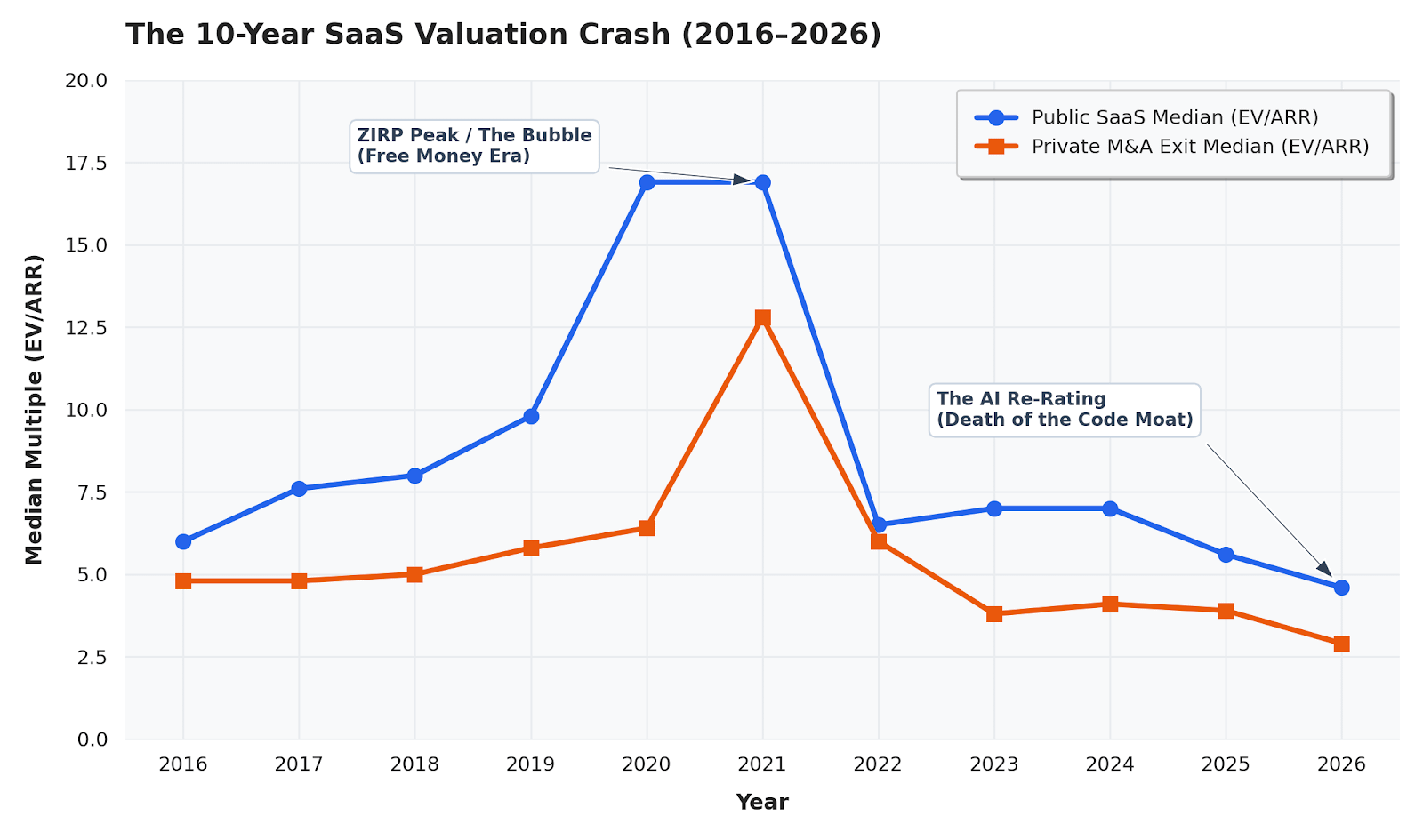
2021 Software Exits were at their all-time high. 17X revenues were expected. An acquirer could buy a software company and be confident that revenue would stay roughly flat for the next 10 years with minimal input. They could run it as a cash cow or upsell to expand ACVs, and with them the value of each customer.
The Revenue Multiple was a good metric to value a company, because the revenue used to be:
A) Sticky
B) Stable (you could cut costs and it held steady)
2026, that’s different. Buying a 10X revenue company today gives a buyer no guarantee that the labs won't replicate the product within two years. Churn has risen sharply because building is easier than ever, which has created a red ocean.
Additionally, switching costs have fallen from a 30-day implementation and database rebuild into a 10-second automatic upload and automatic retrieval of your data. Those changes made software customers less sticky and easier to replace, and revenue harder to forecast..
Software businesses need a new way to be valued.
The Meat
The business model of most of Silicon Valleys AI-native companies:
Revenue = Token Spend forwarded to Customer + 15% Margin for application layer + (sometimes) implementation fee / service fee.
Whether it's called per-seat or usage-based pricing, it comes down to the same thing: the application layer passes most revenue to the labs and keeps a thin margin.
Labs can raise or lower their prices and the willingness of end customers to pay a premium for the application layer varies which makes revenue unpredictable in the long run.
And since the software takes minutes to replicate, revenue is a useless metric for M&A. So if not for revenue, why would anyone buy the company?
The answer is distribution and relationships.
The New Paradigm
I believe that in the near future it will get cheaper in some industries to buy a customer base than to grow organically. What we see today as vertical application layers will become time machines that let consolidators enter markets faster.
Companies will be acquired solely for their distribution and relationships. M&A will become a CAC-arbitrage game, which means it will be cheaper to buy a competitor’s users than to acquire them organically.

The two factors that will define how much a software company is worth at exit are:
“Cleanness of the Ideal Customer Profile (ICP)”: How tightly defined are your customers industry, company size, and decision-maker, and how hard is that market to reach?
Customer Acquisition Costs (CAC): What it typically costs to acquire those customers
Target groups that are hard to reach (scientists, lawyers, Enterprises) will be valued higher than target groups that usually have a cheap CAC (students, early adopters, founders, etc.).
The formula of how companies will get bought: Bending Spoons built a whole company on that theory and we will see their playbook more and more in the AI era: buy a product with a big user base, cut most of the team, keep the users. HubSpot did the same thing with The Hustle, and we saw it with Miro and Airtable as well.
What this means for your business
Revenue will no longer be the defining factor. I believe we will see more and more companies bought solely for their customer base, with the software sunset afterward.
Most founders are still optimizing for building and shipping. It won't be long before they realize that software quality adds little to nothing to their exit valuation.
Stop building. Start selling. Focus on the target group. That’s going to be the value driver.
The ex-Harvard founder already had the answer in his hands: the university access and network he's building is the value driver. He just wasn't optimizing for it. Now he is.